
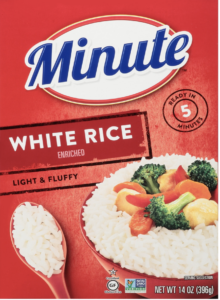
When I was working on the Minute Rice ® marketing early in the 90’s, the brand had a problem. Many people thought Minute Rice was fake because the rice grains were split in a shrimp-like shape. (In reality, the grains looked that way because the rice was pre-cooked, which is why it cooks so fast.) The brand team before mine had spent a lot of money and energy trying to convince people that Minute Rice was real rice. There is pretty much nothing more expensive in marketing than trying to get people to believe something they don’t already think is true, and the campaign wasn’t successful.
My team took a different path. We talked to loyal Minute Rice users to understand why they loved the product, and then we leaned into those insights. It wasn’t just about being fast. Minute Rice was essentially the “tofu of rice,” and it took on the flavors of whatever it was cooked with. There was also a lot of usage with chicken. Instead of fighting the perception battle, we built on what our best customers already loved, and we focused on a Chicken with Minute Rice recipe campaign.
That experience shaped a point of view I’ve been sharing with clients and students for two decades: one of the best ways to develop competitive messaging is to start by understanding why your current customers love you. Once you know that, you can reach out to similar prospects and tell them why they’ll love you for the same reasons.
It’s also why I was excited to read Marcus Buckingham’s recent piece in the Harvard Business Review, What Companies Can Learn from Their Biggest Fans. His article is a terrific examination of customer and employee loyalty, and the specific conditions required to generate them through what he calls “Extreme Positive Experiences.”
The core insight resonates with me. Buckingham’s research shows that the path to real loyalty is to study your most enthusiastic customers, understand what drives their passion, and then build more of that into the brand experience.
Key takeaways from the piece are:
- Study your fans, not your complainers. Real growth comes from understanding and amplifying what your most devoted customers and employees already love.
- “Fine” is not enough. The relationship between positive experience and actual behavior is not proportional. You don’t get a little bit more loyalty from generating a little bit more satisfaction. Outcomes only improve meaningfully when experiences are very positive. A 4 out of 5 and a 5 out of 5 are not even close to the same thing.
- Love is a legitimate business word. Buckingham’s five conditions (Control, Harmony, Significance, Warmth, and Growth) offer a framework for building that kind of loyalty.
Ping me and I’ll gift you a copy of the HBR article. It’s worth your time!